



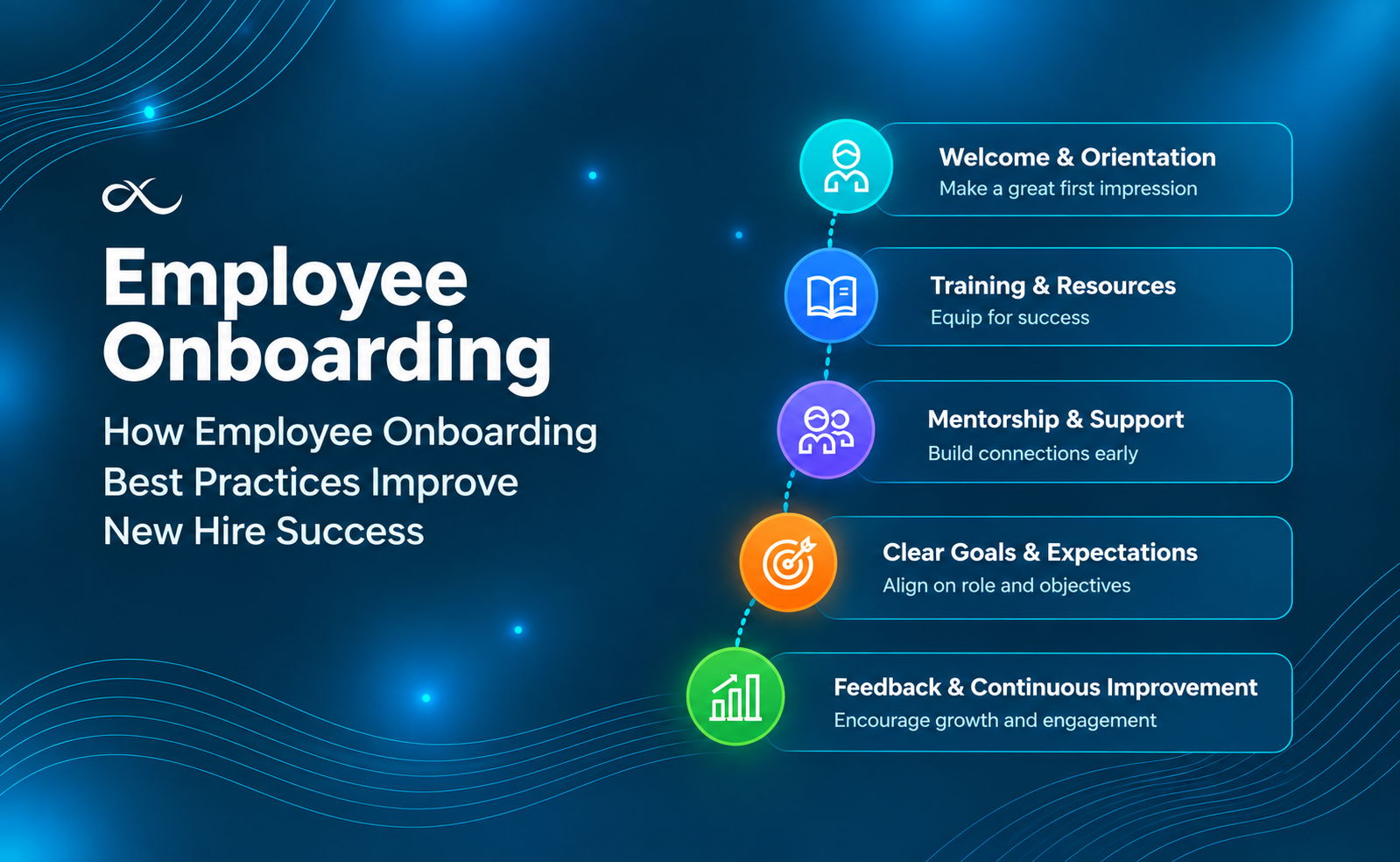
How Employee Onboarding Best Practices Improve New Hire Success
First impressions are made in seconds, but they’re able to cost you a great hire in months. A cutting-edge worker walks in, excited and ready, first-rate to be handed a stack of forms and a quick “figure it out.” No real welcome. No steering. Just confusion. This is exactly how many of our recent hires enjoy day one, and that shaky start rarely fades. It quietly shapes how long they stay, how quickly they find their footing, and whether or not they ever truly feel like a part of the group. This is precisely why employee onboarding best practices matter a lot. A strong onboarding tool is a way extra than office work and a brief job tour. It is the foundation that makes a choice whether or not a new hire grows into a confident, long-term organization member or quietly exits within some months.
In this blog, we will break down what effective onboarding seems like, why it matters, and how you could assemble a better, more steady onboarding journey using clean steps, checklists, and automation.
For extra useful guidelines like this, visit our blog for added insights on going for walks smarter, leaner operations.
Why Employee Onboarding Best Practices Matter More Than You Think
Most companies nonetheless deal with onboarding as a final event. A tour of the workplace, a laptop handover, possibly a welcome email. But studies constantly suggest that employee onboarding done right stretches over weeks, sometimes months, and immediately impacts retention and overall performance.
Here is what is at stake when onboarding is rushed or inconsistent:
- New hires take longer to become simply effective
- Confusion about roles and expectations results in early frustration
- Employees who sense unsupported are much more likely to go away inside the first ninety days
- Managers spend more time firefighting in place of schooling
On the other hand, businesses that follow solid employee onboarding strategies see quicker ramp-up times, more potent engagement, and higher retention numbers. It is not a small operational task. It is an increasing lever.
Understanding the Employee Onboarding Process
Before diving into splendid practices, it enables us to break down what the employee onboarding process truly includes. It is more than the first day. A complete system usually covers four stages.
1. Pre-boarding
This happens before the modern-day hire even walks in. Sending a welcome email, setting up their desks, getting their computer prepared, and sharing what to expect on day one all fall right here. Skipping this stage is one of the most common onboarding errors.
2. Orientation
This is the traditional first day or first week experience. Introductions, business policies, subculture assessment, and essential equipment schooling arise right here.
3. Role Integration
This stage focuses on supporting the ultra-modern lease, understanding their particular responsibilities, meeting their instantaneous crew, and starting contributing to real work with guidance.
4. Ongoing Development
Good onboarding does not forestall after week one. Check-ins at 30, 60, and ninety days assist new hires settle in and give managers a threat to seize problems early.
When those four stages are handled with purpose, new hires experience supported as opposed to thrown into the deep end.

Employee Onboarding Best Practices That Actually Work
Let us get into the practical factor. These are the employee onboarding best practices that constantly produce higher outcomes for both the worker and the company.
Start Before Day One
Do not wait till the new employee walks through the door. Send a welcome packet, verify start information, and get their gadget and tool properly to get right of entry to be ready earlier. This small step without delay reduces day-one anxiety and shows the new hire that the company is prepared and excited to have them.
Assign a Buddy or Mentor
New hires regularly hesitate to ask “small” questions to their manager. Pairing them with a peer pal gives them a stable region to invite whatever without feeling like they’re bothering a person critical. This unmarried exercise can significantly accelerate cultural and social integration.
Set Clear 30-60-90 Day Goals
Vague expectations create pressure. Clear milestones create a path. Outline what fulfillment looks like at every stage so the new hire is aware of precisely what they’ll be running inside the path of and may track their personal development.
Personalize the Experience
Not each feature desires the same onboarding course. A profits lease desires one-of-a-kind schooling than a developer. Tailoring the journey to the feature makes onboarding experience relevant in preference to generic.
Collect Feedback Early and Often
Do not look ahead to an annual survey to find out how onboarding felt. Check in on the first week, month one, and month 3. This offers you real-time perception and indicates to the employee that their voice matters.
Keep Documentation Simple and Searchable
Nobody desires to dig via fifteen PDFs to find out one policy. Centralize onboarding materials so new hires can find solutions on their non-public without out ready on someone else.
The Employee Onboarding Checklist Every HR Team Should Use
Having a documented employee onboarding checklist continues the manner everyday, irrespective of who is running it. Here is an easy framework to build from:
Before Day One
- Send offer letter and welcome email
- Set up money owed, email, and tool get right of entry to
- Prepare computer or remote setup
- Assign onboarding friend
Day One
- Welcome creation and place of job or organization tour
- Review commercial organization company guidelines and lifestyle
- Set up vital equipment and software
- Share the 30-60-90 day plan
Week One
- Role specific schooling starts
- Introduce key stakeholders and pass purposeful organizations
- First take a look at in with supervisor
Month One
- Review early improvement towards goals
- Gather remarks on onboarding experience
- Address any gaps in schooling or access
Month Three
- Formal ninety-day assessment
- Discuss long-term increase route
- Confirm worker feels settled and supported
Keeping a tick list like this visible and regular gets rid of guesswork and makes outstanding now not something slips through the cracks, particularly during busy hiring periods.
Smart Employee Onboarding Strategies for Growing Teams
As companies scale, guiding onboarding will become more difficult to govern. What worked for five new hires a year starts to break down at fifty. This is where smarter employee onboarding strategies are available.
- Standardize the repeatable parts. Documents, account setups, and coverage walkthroughs do not need to be reinvented every time. Build templates once and reuse them.
- Automate the busywork. Sending welcome emails, provisioning money owed, scheduling training commands, and tracking checklists every last touch are exactly the sort of repetitive obligations that devour up HR time without such as a good buy fee while executed manually.
- Track the process, not just the outcome. Knowing where new hires typically get caught permits you to fix the approach in advance than it becomes a bigger retention problem.
This is precisely the sort of operational bottleneck that shows up quietly, one guide mission at a time, until it is costing a way greater hours than each person located out.
Building a Reliable Employee Onboarding Workflow
A strong employee onboarding workflow connects every step we’ve covered into one smooth, trackable tool. Instead of relying on a person remembering to deliver the right e-mail on the right time, a defined workflow makes every new lease get the same immoderate high-quality experience, whether or not they will be the first lease of the 3 hundred and sixty five days or the 50th.
This is where many growing agencies hit a wall. HR agencies juggling recruiting, payroll, and basic general performance management certainly do not have the bandwidth to manually manage each onboarding step for every new rent. That is precisely the form of operational gap that automation is constructed to close, releasing your HR team to focus on people in the workplace.
If your onboarding process runs on spreadsheets, reminders, and guide follow-ups, it might be time to look at what a more automated, end-to-end workflow could look like for your organization.
Conclusion
Onboarding is in no manner a high-quality checklist. It is the first actual flavor a brand new recruit gets of what life at your organization certainly seems like. Get it right, and you bring together confident, dependable organization participants from day one. Get it incorrect, and you quietly lose exquisite people before they even settle in. Companies that spend money on a thoughtful onboarding process, backed by smooth strategies, a strong checklist, and a workflow that scales, see the actual payoff: faster productivity, stronger retention, and happier businesses all around.
The first-rate element? You do not need to fix everything overnight. Start small with pre-boarding, mentorship, smooth milestones, and sincere feedback. Then build a workflow that gets rid of the manual grind, so your HR enterprise can focus on what really matters, supporting humans to achieve success. Ready to prevent chasing onboarding duties by hand? See how automation can quietly address the busywork, from onboarding to invoicing, and deliver your team hours back each week. Talk to AutoLoopers today and see what your operations ought to appear like on autopilot.
FAQ’s
1. What are the key employee onboarding best practices?
The most effective practices include beginning in advance of day one, assigning a mentor or buddy, placing clean 30-60-ninety day goals, personalizing training through the use of features, and collecting feedback often for the duration of the first few months.
2. How long should the employee onboarding process last?
While orientation may take some days, a complete onboarding technique ideally lasts for at least 90 days, with check-ins at key milestones to ensure the new hire is settling in well.
3. Why is an employee onboarding checklist important?
A checklist keeps the process consistent regardless of who manages it. It prevents crucial steps like gadget access or coverage opinions from being ignored, specifically throughout busy hiring seasons.
4. Can employee onboarding be automated?
Yes. Repetitive obligations like sending welcome emails, provisioning accounts, scheduling training, and monitoring checklist completion can all be automatic, releasing up HR agencies to recognition at the human aspect of onboarding.
5. What is the difference between onboarding and orientation?
Orientation is commonly a single occasion, often day one, covering easy introductions and suggestions. Onboarding is the whole process, frequently spanning months, that allows a contemporary-day rent to completely combine into their role and the company’s way of life.employee onboarding best practices.