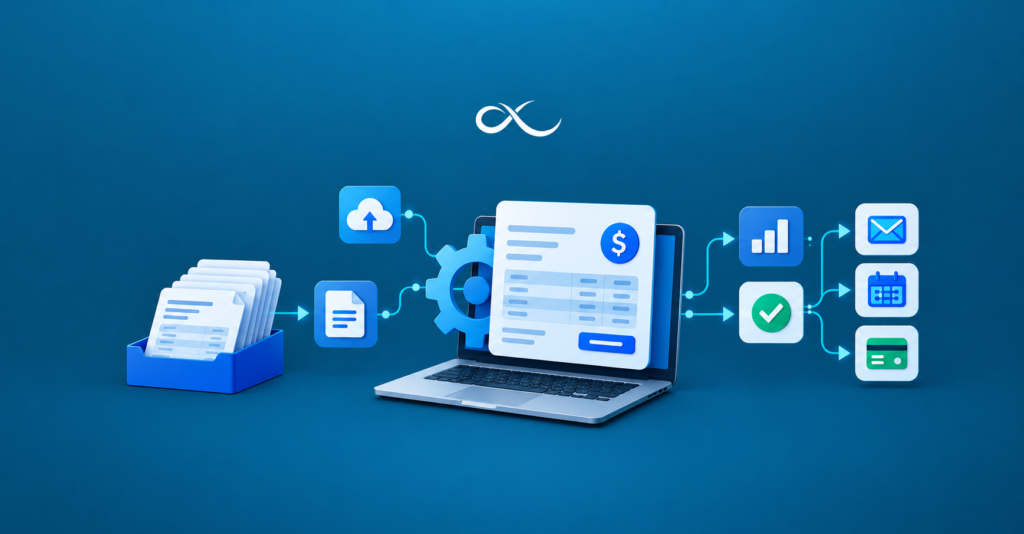




What Is the Future of Automation? 2026 Trends & Predictions

In this article, you will discover the latest predictions and breakthrough trends that are set to revolutionize the B2B service automation landscape in 2026.
Automation is advancing rapidly, powered by improvements in artificial intelligence (AI) and complementary generation. Businesses are increasingly adopting computerized solutions to strain ordinary rate, with key advantages together with fee financial savings, greater employee and customer satisfaction, higher productivity, and a notable cut rate in human error.
Central to this transformation is smart automation (IA), a comprehensive method that integrates robotic process automation (RPA), AI, machine learning (ML), data mining, and business process management (BPM) to automate complex, end-to-end operations.
This is why automation is not just a fashion; it’s a strain that redefines industries and creates new opportunities for organizations globally. From smart automation to included records structures, the future of automation holds thrilling possibilities for companies ready to evolve and innovate.
By 2026, automation is predicted to evolve similarly, with companies that specialize in protected data structures that unify siloed information and supply actionable insights.
Explore the improvements in greater depth and locate the key dispositions and predictions to be able to shape 2026 and beyond!
The Rise of Intelligent Automation
Intelligent automation (IA), which integrates artificial intelligence (AI) with automation technology, is revolutionizing organizational strategies across industries. Unlike conventional automation, IA leverages machine learning, natural language processing, and robotic process automation (RPA) to carry out tasks that require decision-making and flexibility.
The banking and financial services sector is one of the pioneers of AI. Banks are using AI-powered systems for fraud detection, studying transaction patterns in real time to prevent unauthorized transactions. Additionally, loan processing has been streamlined with automation, lessening the effort and time required for credit rating critiques. Customer service has additionally stepped forward with the deployment of AI-driven chatbots, which offer custom designed economic advice and assist 24/7.
Healthcare is one of the distinct industry present procedure a profound transformation through AI. Healthcare providers use AI-powered diagnostic devices to analyze medical images and patient data, which allows faster and further correct diagnoses. RPA is automating administrative duties like billing and patient document control, freeing up healthcare experts to focus on patient care. Virtual fitness assistants are further improving affected individual studies by supporting appointment scheduling and post-treatment follow-ups.
Automation in the Manufacturing Sector
Intelligent automation (IA), which integrates artificial intelligence (AI) with automation technology, is revolutionizing organizational strategies across industries. Unlike conventional automation, IA leverages machine learning, natural language processing, and robotic process automation (RPA) to carry out duties that require decision-making and flexibility.
The banking and financial services sector is one of the numerous pioneers of AI. Banks are using AI-powered systems for fraud detection, studying transaction patterns in real time to prevent unauthorized transactions. Additionally, loan processing has been streamlined with automation, lessening the effort and time required for credit rating critiques. Customer service has additionally stepped forward with the deployment of AI-driven chatbots, which offer custom designed economic advice and assist 24/7.
Healthcare is one of the distinct industry present procedure a profound transformation through AI. Healthcare providers use AI-powered diagnostic devices to analyze medical images and patient data, which allows faster and further correct diagnoses. RPA is automating administrative duties like billing and patient document control, freeing up healthcare experts to focus on patient care. Virtual fitness assistants are further improving affected individual studies by supporting appointment scheduling and post-treatment follow-ups.
Robotics and the Workforce
Robotics is gaining prominence in various industries, no longer as a replacement for human hard work, but as an effective system that enhances and complements personnel.
In the production business enterprise, advanced robotic systems, especially cobots, are designed to work alongside people, taking up repetitive, unstable, or quite particular duties while leaving more complicated and innovative work to human personnel.
The integration of robotics has furthermore delivered about a shift in system roles and required capability units. As automation takes over repetitive and physically taxing jobs, the demand for employees with technical know-how in the areas of robotics programming, maintenance, and device integration has expanded. This shift requires funding for upskilling and reskilling obligations to prepare the workforce for more specialised, higher-paying roles.
The Role of Automation in Customer Experience
Automation is playing an increasing number of crucial roles in enhancing client critiques for the duration of industries. Chatbots, computerized reaction systems, and AI-powered solutions help businesses streamline interactions, decreasing response times and imparting custom designed provider at scale.
Powered by natural language processing (NLP) and machine learning, chatbots can simulate human-like conversations, resolving not unusual consumer inquiries in real time. These automation technologies also use personalization, an essential detail of cutting-edge consumer evaluations. AI-powered gear can test consumer behavior, opportunities, and past interactions to deliver tailor-made guidelines or assistance.
Automation Trends in Data Management
Automation is revolutionizing statistics management techniques, allowing organizations to cope with large volumes of records with more pace, accuracy, and overall performance. As organizations depend more on records, they may be reshaping how they gather, manage, and utilize records through solutions that encompass automated records integration, analytics automation, and advanced information governance.
One key trend is records integration automation, wherein equipment and systems streamline the aggregation of data from diverse assets into unified structures. Modern solutions leverage AI and device reading to map, remodel, and integrate facts from structured and unstructured codecs, making sure consistency and compatibility.
Machine Learning and Predictive Analytics
The intersection of gadget studying (ML) and automation is remodeling predictive analytics. This empowers companies to make smarter, statistics-driven choices with more accuracy and speed. By automating data processing, evaluation, and forecasting, businesses find patterns and insights that conventional methods formerly concealed or made too complicated to stumble upon.
Beyond deliver chains, predictive analytics pushed with the aid of ML is reshaping industries, which includes finance, healthcare, and retail. Financial institutions use computerized predictive models to detect fraudulent activity, while healthcare providers leverage that gear to assume affected character effects and personalize treatment plans.
Cloud Automation: Local vs. Remote Solutions
Cloud automation improves the way businesses manage their IT environments. It provides the possibility to streamline workflows, optimize resources, and reduce operational overhead. However, when adopting cloud automation, businesses face a critical decision: whether to implement local (on-premises) or remote (cloud-based) automation solutions.
Local solutions offer greater control and customization, making them ideal for businesses with strict security or compliance requirements. Remote automation solutions hosted in public or private clouds offer unparalleled scalability and flexibility. Ultimately, the choice depends on an organization’s specific goals, resources, and constraints.
Automation Security Challenges
As automation becomes a cornerstone of modern business operations, it also introduces unique security challenges. Automated environments can create vulnerabilities due to their reliance on interconnected systems and complex workflows.
One major security risk is unauthorized access. Automated systems often rely on APIs, scripts, and credentials to interact with other systems, making them prime targets for cyberattacks. To mitigate these risks, organizations should implement robust access controls, regularly audit and monitor processes, and prioritize patch management.
Future of Automation: What to Expect
The future of automation promises to be transformative. One key trend to watch is the rise of hyper-automation, which combines multiple automation tools and technologies to streamline entire workflows end-to-end. Hyper-automation goes beyond task-level automation by integrating AI, ML, RPA, and analytics to enable dynamic and intelligent decision-making.
Cognitive automation is reshaping industries by mimicking human thought processes to perform tasks that require judgment and creativity. As these trends unfold, organizations must embrace a forward-looking mindset to stay competitive in the b2b service automationmarket trends 2026.
Conclusion
It is a fact that automation has become a key driver of innovation, efficiency, and growth across industries. From improving customer experiences through AI-powered chatbots to simplifying data management with automated integration and analytics, the potential of automation continues to grow.
As businesses increasingly rely on automated systems to stay competitive, addressing challenges such as security, system integration, and workforce adaptation will be essential to gaining the full benefits of automation. The future of automation promises even greater transformation through advancements in hyper-automation, autonomous systems, and AI-powered solutions.
Want to explore how automation can improve your business operations? Contact Autoloopers to discover practical automation solutions designed to help your business save time, improve efficiency, and support long-term growth.
Autoloopers is committed to helping businesses navigate this evolving automation landscape. With a deep understanding of emerging technologies and a proven track record of implementing effective automation solutions, Autoloopers is well-positioned to support organizations in leveraging automation to its fullest potential. Whether it’s optimizing manufacturing processes, enhancing customer service through AI, or streamlining data management, Autoloopers’ tailored solutions ensure that businesses can achieve operational excellence, reduce costs, and accelerate innovation.
Partnering with Autoloopers allows businesses to stay ahead in the automation curve, adopting cutting-edge tools that drive both efficiency and creativity. Through strategic staff increase, companies can benefit from expert guidance in integrating automation seamlessly into their existing processes, empowering teams to focus on higher-value tasks while automating routine and repetitive activities.
With Autoloopers expertise and dedication to delivering results, organizations are able to harness the full power of automation and secure long-term success in an increasingly automated world.