



How to Build High-Converting Client Onboarding Workflows in GoHighLevel
Learn how to build a high-converting client onboarding workflow in GoHighLevel — with intake forms, welcome sequences, SOPs, and a free checklist.
“Most agencies don’t lose clients because of bad work they lose them in the first two weeks, before any real work even starts.”
A broken client onboarding process is held together with email threads, forgotten intake forms, and a kickoff call nobody confirmed. By the time the client gets nervous enough to ask “is this normal?”, you’ve already lost the relationship. A well-built client onboarding workflow fixes this permanently. It’s not a nice-to-have it’s the difference between agencies that scale smoothly and agencies that burn out their ops team chasing signatures and intake forms manually. And if you’re running on GoHighLevel, you already own every tool needed to build one without adding a single extra subscription.
This guide breaks down exactly how to build a client onboarding workflow in GoHighLevel that converts new sign-ups into confident, paying clients — step by step, with templates, an SOP framework, and the KPIs that prove it’s working. Want this done for you instead? See how AutoLoopers builds GoHighLevel automation systems for agencies that don’t have time to DIY it.
Why Your Client Onboarding Process Is Costing You Clients (Even If You Don’t See It)
A broken client onboarding process doesn’t usually look broken from the inside. It looks like “normal agency chaos” a missed intake form here, a delayed kickoff call there. But from the client’s side, every gap reads as disorganization.
Here’s what a weak process actually costs:
- Refund and churn risk clients who feel lost in the first 7 days are the most likely to cancel before real value is delivered.
- Wasted account manager hours manually chasing signatures, forms, and scheduling can eat 3-5 hours per client in the first week alone.
- Inconsistent delivery without a repeatable client onboarding workflow, every team member runs onboarding differently, which means quality varies wildly.
- Lost referral potential a sloppy first impression rarely turns into a 5-star review or a referral, no matter how good the actual service is later.
None of this is a sales problem. It’s a systems problem and it’s entirely fixable with automation.
What Makes a Client Onboarding Workflow “High-Converting”?
A high-converting workflow isn’t just “automated.” It’s automated and designed around the client’s psychology in the first 14 days. Three things separate a high-converting workflow from a generic one:
- Speed the first touchpoint after signing happens within minutes, not days.
- Clarity the client always knows what’s next without having to ask.
- Consistency every client gets the same polished client onboarding experience, regardless of who on your team is handling it.
GoHighLevel is built to deliver all three because it combines CRM, forms, pipelines, calendars, and messaging in one system no duct-taping five tools together.
The 7 Client Onboarding Steps Every GoHighLevel Workflow Needs
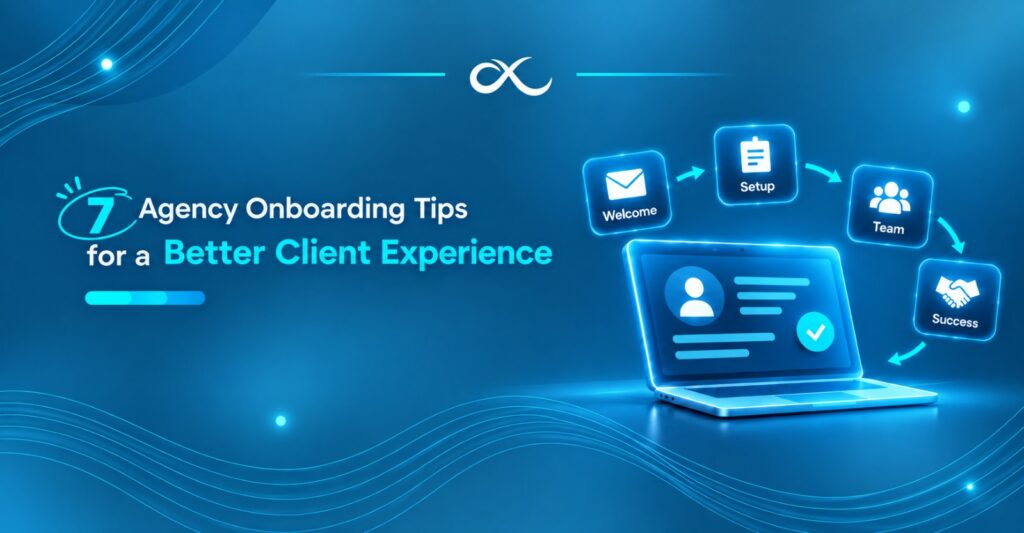
These client onboarding steps form the backbone of the workflow. Build them in this order inside GoHighLevel and you’ll have a fully automated system within a day.
Step 1: Contract Signing & Payment Collection
Use GoHighLevel’s e-signature and invoicing tools to trigger the entire workflow the moment a contract is signed and the first payment clears. This single event should fire a workflow trigger nothing downstream should require manual starting.
Step 2: New Client Intake Form
A new client intake form should go out automatically within minutes of payment. Keep it short (8-12 fields max) and only ask for what you genuinely need to start work goals, brand assets, access credentials, key contacts. Long forms kill completion rates.
Step 3: Automated Welcome Sequence
This is where most agencies under-deliver. A proper welcome sequence spans email, SMS, and even a short voicemail drop not just one “thanks for signing up!” email. It should set expectations: what happens next, when the kickoff call is, and who their point of contact is.
Step 4: Pipeline & Tag-Based Tracking
Move every client through a dedicated onboarding pipeline (e.g., Signed → Form Submitted → Kickoff Scheduled → Active) using tags to trigger the next automation automatically. This gives your team full visibility without status-update meetings.
Step 5: Kickoff Call Scheduling
Embed a self-booking calendar link directly inside the welcome sequence so clients can pick their own kickoff slot no back-and-forth emails required.
Step 6: Task Assignment & Internal Notifications
Once the intake form is submitted, GoHighLevel should auto-assign internal tasks to the right team member based on package or service type, with a Slack/email notification so nothing sits untouched.
Step 7: Client Portal Access
Give clients a single, branded place to check progress, submit documents, and message your team instead of digging through email threads. This is one of the most underused features in GoHighLevel and one of the easiest wins for improving client onboarding experience.
Building an Onboarding SOP (Standard Operating Procedure) Inside GoHighLevel
Automation without documentation falls apart the moment your team changes. That’s why every client onboarding workflow needs a written onboarding SOP (standard operating procedure) behind it a simple reference doc that maps:
- Every trigger and the action it fires
- Who owns each manual touchpoint (if any remain)
- What “done” looks like at each pipeline stage
- Escalation steps if a client doesn’t respond within X days
Store this SOP inside a pinned note in GoHighLevel or your internal wiki, and review it every quarter. Workflows decay silently an SOP is what keeps the automation honest. Need help documenting and auditing your current onboarding SOP? This is exactly what AutoLoopers’ free diagnostic uncovers.
How to Set Up Automated Client Onboarding in GoHighLevel (Step-by-Step)
Here’s the practical build order for automated client onboarding:
- Create the trigger “Invoice Paid” or “Contract Signed” inside Workflows.
- Add a tag (e.g.,
onboarding-started) to segment these contacts. - Send the intake form via the next workflow action, with a 24-hour follow-up reminder if it’s not submitted.
- Branch the workflow based on form submission submitted vs. not submitted gets different follow-up paths.
- Trigger the welcome sequence (email + SMS) immediately after the tag is applied.
- Move the pipeline stage automatically as each milestone (form, call booked, call completed) is hit.
- Fire internal task creation the moment the form is submitted, assigned by round robin or service type.
- Grant client portal access as the final automated step, with login instructions sent via SMS for higher open rates.
Test the entire sequence with a dummy contact before going live broken onboarding automation is worse than no automation at all, because it erodes trust faster than a manual process would.
Free Client Onboarding Checklist Template
Use this onboarding checklist as your build reference or hand it directly to clients as a “what to expect” PDF:
- Contract signed and payment confirmed
- Welcome email + SMS sent within 5 minutes
- Intake form sent (and reminder scheduled if incomplete after 24 hrs)
- Kickoff call booked via self-scheduling link
- Client tagged and moved to onboarding pipeline
- Internal task assigned to account owner
- Client portal access granted
- Day 7 check-in message sent automatically
- Day 14 “how’s it going” survey triggered
This checklist doubles as your QA list run a new client through it monthly to catch where automations may have quietly broken.
Client Onboarding Software: Why GoHighLevel Beats Spreadsheets and Disconnected Tools
Plenty of agencies try to manage onboarding with a Google Sheet, a Calendly link, a separate form tool, and email reminders set manually. The problem isn’t effort it’s fragmentation. Every handoff between tools is a place where a client falls through the cracks.
Client onboarding software like GoHighLevel solves this by keeping the contact, the form data, the pipeline stage, the messaging history, and the calendar all in one record. That means:
- No double data entry between tools
- One source of truth for “what stage is this client in”
- Automation triggers that don’t depend on someone remembering to update a spreadsheet
- Reporting on bottlenecks (e.g., “40% of clients stall at the intake form stage”) that a spreadsheet simply can’t surface
If you’re already paying for GoHighLevel, you don’t need another onboarding tool you need to actually use the automation layer you’re sitting on. See AutoLoopers’ GoHighLevel setup and automation services if you’d rather have it configured correctly the first time.
Designing a Welcome Sequence That Builds Instant Trust
A generic “Welcome aboard!” email isn’t a welcome sequence it’s a single message. A real sequence does three things over the first 72 hours:
- Confirms the decision reassures the client they made the right call.
- Sets the timeline tells them exactly what happens and when, removing the anxiety of the unknown.
- Introduces the human a face, name, and direct contact method for their point person, even if AI/automation handles the logistics.
Use personalization variables (name, package, start date) so it doesn’t read as a mass blast, and mix channels an SMS often gets opened faster than an email in the first hour after signing.
5 Mistakes That Wreck the Client Onboarding Experience (and How to Fix Them)
- Asking for too much, too soon. A 25-field intake form on day one feels like homework. Split it into a short initial form and a deeper follow-up later.
- No fallback for non-responders. If a client doesn’t submit the form or book a call within 48 hours, you need an automated nudge not a manual reminder someone forgets to send.
- Treating onboarding as “sales handoff” instead of a process. Sales and delivery teams need shared visibility, or context gets lost at the handoff.
- No clear “what happens next” messaging. Silence between steps is the #1 driver of client anxiety in the first two weeks.
- Never auditing the workflow. Automations that worked a year ago may be broken today due to a changed form field or renamed pipeline stage. Audit quarterly against your onboarding SOP.
Customer Onboarding Automation: Measuring What Matters (KPIs & Benchmarks)
You can’t improve what you don’t measure. Track these to know if your customer onboarding automation is actually working:
- Time to first response should be under 5 minutes after signing
- Intake form completion rate aim for 85%+ within 48 hours
- Kickoff call show-up rate automated reminders typically lift this by 20-30%
- Time from sign-up to “active” pipeline stage shorter is almost always better
- Early churn rate (first 30 days) this is the clearest signal of onboarding health
- CSAT or NPS at day 14 a direct read on client onboarding experience
Review these monthly. A workflow that looked great at launch can quietly degrade as your service offerings or team change. Want a second set of eyes on your current onboarding metrics? AutoLoopers’ diagnostic process benchmarks this for free before recommending anything.
Ready to Stop Building This Manually?
Our done-for-you GHL Auto-Onboarding snapshot installs the entire system above intake automation, welcome sequences, pipeline logic, and task assignment directly into your GoHighLevel account in minutes. Get the GHL Auto-Onboarding Snapshot →
Frequently Asked Questions
What is a client onboarding workflow?
A client onboarding workflow is the automated sequence of steps contracts, intake forms, welcome messages, scheduling, and task assignments that moves a new client from “signed” to “fully set up and active” without manual chasing at every step.
How long should client onboarding take?
Most service businesses should aim for 7-14 days from signing to fully active. Anything longer increases churn risk; anything much shorter may skip steps clients need to feel confident.
Can GoHighLevel fully automate client onboarding?
Yes. GoHighLevel can handle contract triggers, intake forms, welcome sequences, pipeline tracking, task assignment, and client portal access covering close to 100% of the onboarding process without needing a separate tool.
What should be included in an onboarding checklist?
At minimum: signed contract confirmation, completed intake form, scheduled kickoff call, pipeline stage updates, internal task assignment, and client portal access. See the full checklist template above.
How do I know if my onboarding process needs fixing?
Watch for early churn (clients canceling in the first 30 days), low intake form completion rates, or frequent “what’s next?” questions from clients all are signs the client onboarding workflow has gaps.
Conclusion
A high-converting client onboarding workflow isn’t built once and forgotten it’s a living system that needs the right steps, a documented SOP, and regular audits to keep delivering a consistent experience as you scale. GoHighLevel gives you every tool required to build this without bolting on extra software; the only missing piece is usually time and the right blueprint.
If you’d rather have this built, tested, and audited for you instead of piecing it together yourself, AutoLoopers specializes in exactly this done-for-you GoHighLevel automation built around your actual bottlenecks, not templates.
Book a free diagnostic with AutoLoopers today and see exactly where your onboarding process is leaking clients.